Precious Metal Jewelry Materials: A Complete Overview
Precious metal jewelry represents one of humanity's most significant achievements in material craftsmanship. Gold, silver, platinum, and palladium are widely used in jewelry making not because of any mystical qualities, but due to their quantifiable physical properties, chemical stability, and workability. This guide provides a systematic overview of precious metal characteristics, alloy systems, manufacturing processes, and practical consumer insights.
1. Material Science Fundamentals for Jewelry Metals
1.1 Physical Properties That Make Metals Suitable for Jewelry
Among the 118 elements in the periodic table, only eight are classified as precious metals: gold (Au), silver (Ag), platinum (Pt), palladium (Pd), rhodium (Rh), iridium (Ir), osmium (Os), and ruthenium (Ru). These eight elements are prioritized for jewelry applications based on the following measurable physical criteria:
| Property | Gold | Silver | Platinum | Palladium |
|---|---|---|---|---|
| Density (g/cm³, 20°C) | 19.32 | 10.49 | 21.45 | 12.02 |
| Melting Point (°C) | 1064 | 962 | 1768 | 1555 |
| Mohs Hardness | 2.5 | 2.5 | 4.5 | 5.0 |
| Color | Golden Yellow | White | Silver-White | Silver-White |
| Oxidation Resistance | Excellent | Moderate | Excellent | Good |
Key Selection Criteria Explained:
- Density determines the "heft" of jewelry—higher density means more weight per volume, enhancing perceived value. Platinum and gold offer a substantial feel that distinguishes them from lighter metals.
- Melting point dictates equipment requirements. Gold's 1064°C melting point allows traditional torch soldering, while platinum's 1768°C requires high-frequency induction or laser welding systems, significantly raising production costs and technical barriers.
- Hardness directly impacts scratch resistance and deformation resistance. Pure gold and silver are too soft for stone setting or intricate designs—alloying is essential for improving these properties.
- Color is the primary visual cue for consumers. Different alloy formulations produce varying hues, which forms the technical basis for the karat gold color system.

1.2 Why Alloying Is Essential—Not Using Pure Metals for Jewelry
Pure gold (24K) and pure silver have a Mohs hardness of only 2.5—meaning they can be scratched with a fingernail. Rings and bracelets made from pure metals deform easily during daily wear, and gem-setting becomes unreliable due to insufficient grip on stones. For this reason, the jewelry industry rarely uses pure metals for complex designs or mounted pieces.
The core principle of alloying is to introduce other metal elements to modify the host metal's crystal structure, creating solid-solution strengthening or precipitation hardening effects. This increases yield strength and surface abrasion resistance. Alloying also alters color, casting fluidity, and solder compatibility.
Take 18K gold as an example—it contains 75% gold by weight, with the remaining 25% composed of silver, copper, zinc, nickel, or cobalt. The specific formulation determines the final alloy's color and mechanical performance:
- Yellow gold: Gold + silver + copper (ratios adjusted from light yellow to deep gold tones)
- Rose gold: Gold + copper (high proportion) + silver (low)—higher copper content intensifies the reddish hue
- White gold: Gold + nickel (or palladium) + zinc + copper—bleaching elements offset gold's natural yellow color. Note: white gold is typically rhodium-plated for enhanced whiteness, and the plating wears off over time, requiring re-plating
- Colored gold alloys (green, purple, blue): Achieved by adding specific ratios of silver, aluminum, indium, etc.—these are mostly used in artistic jewelry with limited market circulation
Process Note: When soldering different colored gold alloys, the solder composition must match the base material—otherwise, discoloration or corrosion may occur at joints. Batch-to-batch consistency of alloy formulas is critical in production.
2. Gold Alloy Jewelry: Material Systems & Manufacturing
2.1 Gold Purity Grades and Application Scenarios
| Purity Grade | Gold Content (‰) | Marking | Typical Applications |
|---|---|---|---|
| Fine Gold | ≥990 | AU990 | Traditional plain gold bangles, rings, necklaces |
| 24K Gold | ≥999 | AU999 | Investment bars, minimalist plain-gold pieces |
| 22K Gold | ≥916 | AU916 | Hard-gold electroforming, lightweight designs |
| 18K Gold | ≥750 | AU750, 18K | Stone setting, fashion designs, mass production |
| 14K Gold | ≥585 | AU585, 14K | Popular in Western markets, daily-wear durable pieces |
Selection Guidelines:
- Fine Gold/24K: Best for simple unset pieces (polished bangles, bead necklaces, traditional wedding sets). Advantage: high purity. Disadvantage: softness limits complex designs and stone setting.
- 18K Gold: The global industry standard—balances hardness (approx. 130–180 HV), ductility, and color versatility. Suitable for the full jewelry manufacturing workflow: lost-wax casting, finishing, stone setting, polishing. Most high-end branded mounted jewelry uses 18K gold.
- 22K Gold: Gained popularity in markets like China through hard-gold electroforming, which increases surface hardness while allowing hollow, lightweight structures with relatively high gold content—appealing to younger consumers seeking "large size, lower total price."
2.2 The Karat Gold Color System and Formulation Logic
Gold alloy color variation is a direct result of formulation adjustments—it is not a surface treatment or plating. Key formulation principles:
- Yellow Karat Gold: Gold + silver + copper—ratios adjusted to achieve hues from pale yellow to deep rich gold.
- Rose Karat Gold: Gold + copper (high) + silver (low)—higher copper creates a stronger reddish tone.
- White Karat Gold: Gold + nickel (or palladium) + zinc + copper—bleaching elements counteract gold's yellow undertone. Note: White gold is typically rhodium-plated for brightness and whiteness; with daily wear, the plating wears and requires re-plating.
- Colored Golds (green, purple, blue): Achieved by adding specific proportions of silver, aluminum, indium, etc.—these are niche products primarily used in art jewelry with limited market share.
Process Alert: When joining different colored gold alloys, solder composition must match the base metal—otherwise, color differences or corrosion may appear at joints. Strict batch-to-batch consistency of formulas is essential in mass production.
2.3 Primary Manufacturing Processes for Gold Jewelry
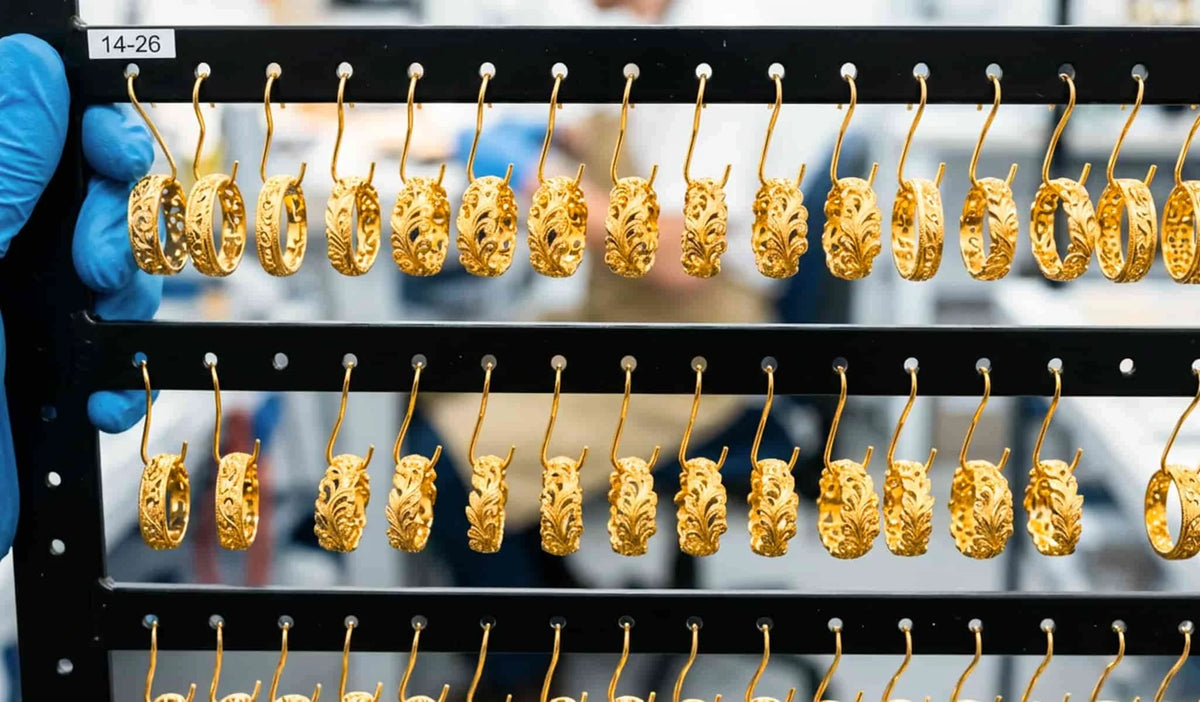
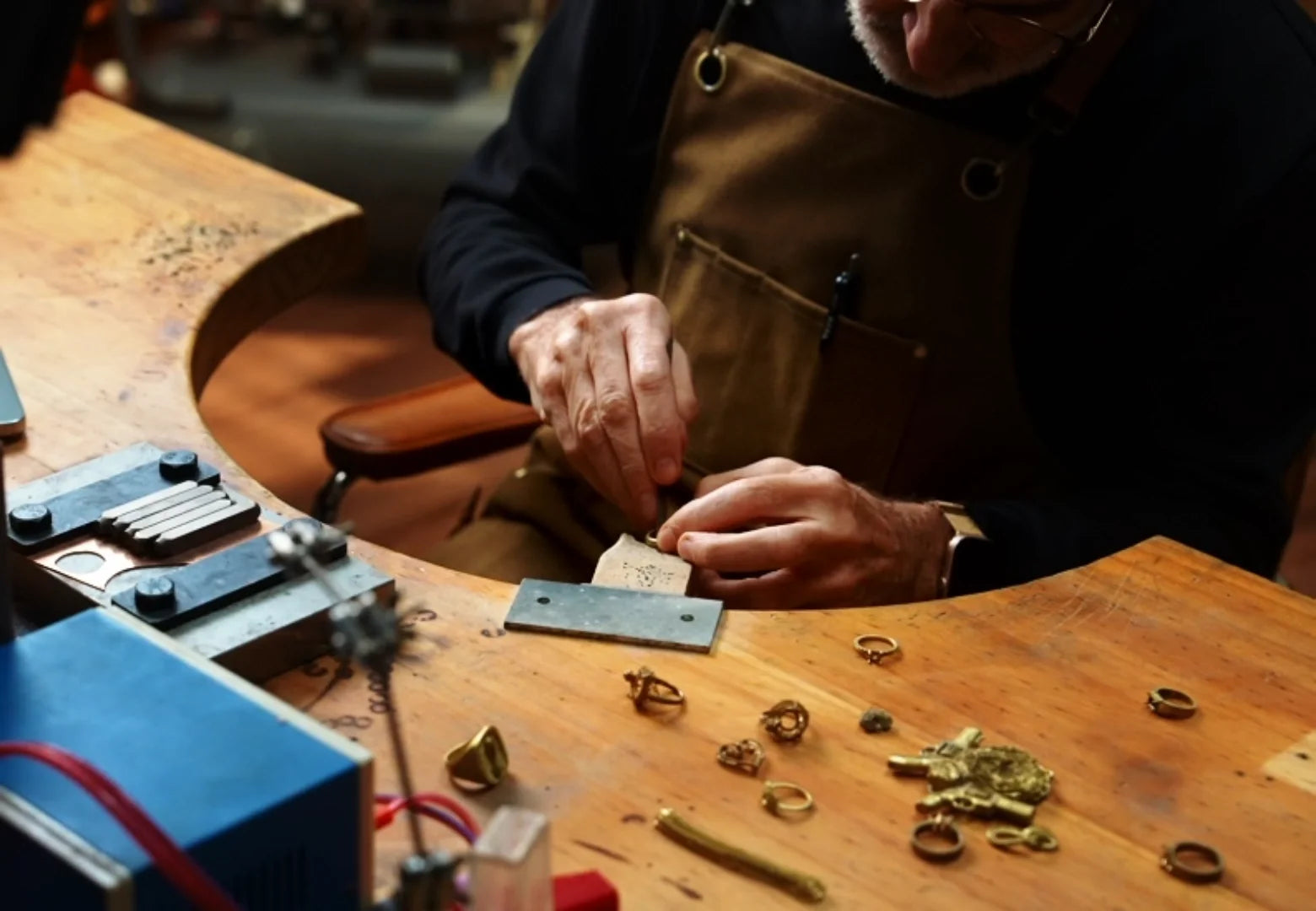
- Lost-Wax Casting: Wax models are invested in refractory material to form a shell, the wax is burned out, and molten alloy is injected. Ideal for complex shapes and batch production—dimensional tolerances can be held to ±0.05mm. This is the most common production method for set jewelry.
- Stamping/Die Striking: Steel dies and presses form shapes from sheet metal. Suitable for simple geometric forms and high-volume standard components (plain rings, pendant bases)—offers high efficiency and low unit cost.
- Electroformed Hard Gold: Gold is electrodeposited onto a conductive model from a gold-salt electrolytic bath. Creates hollow structures with 0.2–0.3mm wall thickness and surface hardness of 90–120 HV. Enables 22K gold rings with substantial volume at lower gold weight, though hollow designs are vulnerable to denting from impact and difficult to repair.
- Enamel/Champlevé: Enamel powders are fused into recessed metal cells at high temperatures to create glass-like surfaces. This is a surface decoration technique independent of the base metal's purity.
- Machine Chain Making: Automatic lathes or knitting machines convert gold wire into various chain structures (e.g., O-chain, box chain, Singapore chain)—the primary manufacturing method for necklaces and bracelets.
2.4 Hardness and Wear Resistance Relationship
| Material | Vickers Hardness (HV) | Scratch Resistance | Deformation Resistance |
|---|---|---|---|
| 24K Gold | ~40 | Low | Low |
| 22K Hard Gold | 90–120 | Moderate | Moderate (hollow structures are fragile) |
| 18K Gold | 130–180 | High | High |
| 14K Gold | 160–200 | Very High | Very High |
Higher hardness means surfaces maintain polished finishes longer on high-friction areas like rings. However, increased hardness also raises production difficulty—sawing, soldering, and polishing consume more time and tooling. This is a trade-off manufacturers must evaluate during material selection.

3. Silver Jewelry: Materials & Care
3.1 Fine Silver vs. 925 Sterling Silver
| Property | Fine Silver (≥990‰) | 925 Sterling Silver |
|---|---|---|
| Silver Content | ≥990‰ | ≥925‰ |
| Hardness (HV) | ~40 | ~70–80 |
| Oxidation Resistance | Moderate | Moderate (similar) |
| Polish Luster | High | High |
| Primary Use | Traditional silverware, bullion | Jewelry, tableware, instruments |
925 sterling silver (92.5% silver, balance copper) is the internationally recognized standard for silver jewelry. The 7.5% copper addition significantly improves hardness and wear resistance, making it suitable for daily wear and light stone setting. Fine silver is too soft for most jewelry applications except for specific hand-hammered traditional pieces.
3.2 Silver Tarnish Mechanism and Care
Silver is chemically less stable than gold. Over time, it reacts with hydrogen sulfide (H₂S) in the air to form silver sulfide (Ag₂S), creating a yellow → brown → black discoloration on the surface. This is a normal chemical phenomenon, not a material defect.
Factors Affecting Tarnish Rate:
- Environmental sulfur content (rubber products, certain cosmetics, sulfur compounds in perspiration)
- Humidity (higher humidity accelerates reaction)
- Temperature (elevated temperatures speed up tarnishing)
Care Methods:
- Polishing cloth: Mechanically removes the sulfide layer; suitable for light tarnish.
- Silver dip/cleaning solution: Chemically dissolves silver sulfide—but also causes slight loss of the silver base; avoid frequent use.
- Ultrasonic cleaner with mild detergent: Removes dirt and oils that accelerate tarnishing, but does not directly remove existing sulfide layers.
- Electrochemical reduction: Converts silver sulfide back to metallic silver—efficient, minimal loss, but requires professional equipment.
Daily Care Tips: Wipe pieces with a soft cloth after each wear to remove sweat and cosmetic residues. Store in sealed bags to minimize air exposure. Avoid contact with rubber items and sulfur-containing soaps. Note that tarnish does not reduce the silver's material value—proper cleaning restores its original luster.
3.3 Silver's Workability Advantages
Silver's low melting point (962°C) and excellent ductility make it more workable than gold and platinum, giving it broader applications in handcrafted jewelry:
- Repoussé/Chasing: Uses silver's softness to shape three-dimensional vessels or jewelry components through hand hammering.
- Engraving: Various gravers carve decorative patterns—a traditional fine-metal technique.
- Filigree: Silver wire drawn to 0.2mm or finer is woven, coiled, and soldered into openwork structures.
- Antiquing/Oxidized finish: Deliberate sulfidation creates a uniform black surface, then localized polishing produces contrasting black-and-white decorative effects.
Silver's low hardness is an advantage in traditional handcrafts (easy shaping) but a disadvantage in high-volume industrial production (insufficient wear resistance). This dual nature defines silver's market position—it works best for design-driven pieces with high manual value, rather than hard-wearing daily functional items.
4. Platinum Group Metals: Platinum & Palladium
4.1 The Processing Challenges of Platinum Jewelry
Platinum's history in the Chinese jewelry market spans just over 30 years, yet China has become the world's largest consumer. The key technical challenges arise from its physical properties:
- Melting point 1768°C: Significantly higher than gold's 1064°C—traditional oxy-acetylene torches can't achieve this; high-frequency induction or laser welding is required.
- High-temperature oxidation resistance: Platinum is the only metal that resists oxidation up to its melting point—beneficial in processing (no surface oxidation) but requires higher de-oxidation and degassing control.
- High density (21.45 g/cm³): About 11% heavier than gold per volume—this gives a satisfying heft but also increases material cost for equal volume.
- Gas absorption: Platinum dissolves hydrogen and oxygen in the molten state—if gases are not completely expelled during solidification, internal porosity results, lowering yield. Vacuum or protective-atmosphere casting is essential.
| Purity Grade | Platinum Content (‰) | Marking |
|---|---|---|
| Fine Platinum | ≥990 | PT990 |
| Platinum 950 | ≥950 | PT950 |
| Platinum 900 | ≥900 | PT900 |
| Platinum 850 | ≥850 | PT850 |
PT950 is the most popular choice in China, balancing high purity with sufficient hardness. However, note that platinum's hardness (~40–60 HV) still falls below 18K gold (~130–180 HV). For stone setting, platinum's grip strength is weaker—prongs for larger gems must be appropriately thickened to ensure security.
4.2 Platinum's Surface Finish Advantage
Platinum's high density and uniform microstructure produce a distinct silver-white luster after polishing. Unlike white gold, which relies on rhodium plating for whiteness, platinum's natural color is pure silver-white. This eliminates the need for electroplating—scratches on platinum still reveal white metal beneath, not the yellowish base that appears when rhodium plating on white gold wears through.
This "body color is white" characteristic is platinum's core selling point as a white precious metal and also offers a production advantage—eliminating the plating step reduces manufacturing time and associated environmental costs.
4.3 Palladium Jewelry: Properties and Market Position
Palladium entered jewelry applications later than platinum, mainly due to its challenging workability:
- Melting point 1555°C: Similar to platinum, requiring comparable welding and casting equipment.
- Extreme hydrogen absorption: Palladium can absorb up to 3,000 times its volume in hydrogen at room temperature—improper processing leads to embrittlement and internal porosity.
- Density 12.02 g/cm³: About 56% that of platinum—noticeably lighter in hand for equal volume.
Market Differentiation: Palladium jewelry is typically priced lower than platinum, appealing to buyers with tighter budgets who prefer a white-metal appearance. However, palladium is the most chemically active among the platinum group—it dissolves in concentrated nitric and hot sulfuric acids, offering weaker corrosion resistance than platinum. Currently, palladium holds a significantly smaller market share than platinum, with more limited design options.
4.4 Clarifying the "White Gold" Terminology
Important clarification: The traditional Chinese term "白金" (bái jīn) historically referred to a "white alloy" of silver, copper, and zinc—possibly containing no platinum or palladium whatsoever. In modern commercial language, "platinum" specifically means the element Pt, while "white karat gold" refers to gold alloyed with nickel or palladium to neutralize its yellow tone. Consumers should always rely on the actual stamp/marking (e.g., PT950, AU750) as the sole basis for identification, not verbal claims.
5. Supporting Metals in Jewelry Processing: Rhodium, Iridium & Others
Most consumers never purchase pure rhodium or iridium jewelry, but these elements play vital functional roles in jewelry manufacturing:
| Element | Role in Jewelry Processing |
|---|---|
| Rhodium (Rh) | Electroplated layer on white gold—provides brilliant whiteness and protective abrasion resistance; typical thickness 0.1–0.5 microns |
| Iridium (Ir) | Added as a hardening agent in platinum alloys (e.g., PT900 often contains small amounts of iridium) to improve wear resistance |
| Ruthenium (Ru) | Similar to iridium—used for platinum alloy hardening |
| Osmium (Os) | Extremely brittle—not used in jewelry; primarily for cemented carbides |
Rhodium plating is a standard finishing step for white karat gold jewelry. However, the plating gradually wears off with daily use, revealing the yellowish base metal underneath—at which point the piece needs to be returned to the workshop for re-plating. Plating thickness and application quality vary between manufacturers, directly affecting how long a white gold piece "stays white." The concept of "never-fading white gold" does not exist—the rhodium layer is essentially a consumable surface.
Iridium and ruthenium are typically added to platinum at 5–10% concentrations. Appropriate additions improve scratch resistance, but excessive amounts increase brittleness and reduce ductility and solderability. Optimizing alloy formulations is a classic materials engineering trade-off.