WJ530 vs WJ51C: Which Flashforge Wax 3D Printer Fits Your Jewelry Business?
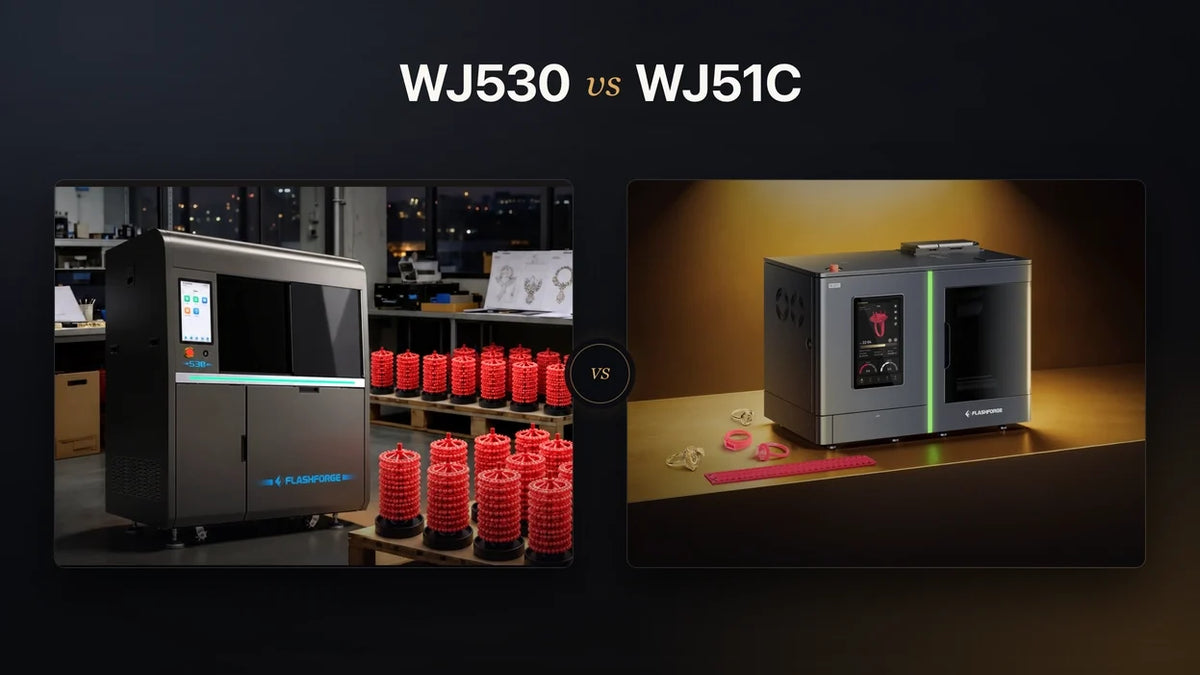
The Flashforge WJ51C and WJ530 deliver the same print precision: 2900 × 2900 × 1700 DPI resolution, 15 μm layers, and a red castable wax paired with a white support wax. What separates them is scale — a 3.2-liter build chamber versus 9.0 liters, one printhead versus three, and up to 3 kg of wax patterns per month versus 12 kg. This comparison walks through what the two machines share, where they genuinely differ, and which one fits your jewelry business.

What Do the Two Printers Share?
The two machines share the same print specifications, listed below. Both are MultiJet Printing (MJP) machines that jet 100% real casting wax, not photopolymer resin. (Our guide to what 2900 × 2900 × 1700 DPI means in wax 3D printing explains what that resolution delivers on a castable surface.)
| Shared specification | WJ51C & WJ530 |
|---|---|
| Print process | MJP — 100% real casting wax, no photopolymer |
| Resolution / layer thickness | 2900 × 2900 × 1700 DPI / 15 μm |
| Dimensional accuracy | ±0.04 mm per 20 mm |
| Pattern wax / support wax | Red castable wax for the pattern / white support wax that dissolves in solution |
| Shrinkage / ash content | Linear shrinkage 0.7% · volumetric shrinkage 1.1% · ash content 0% |
| Slicing software | WaxJetPrint — accepts STL and SLC files, runs on Windows 10/11 64-bit |
With shrinkage already compensated in the wax, patterns from either machine go straight into a plaster mold and burn out clean — the same lost-wax casting routine jewelers have used for centuries, minus the hand carving.
The software point is worth one line: both printers slice with WaxJetPrint, so a designer trained on one machine can run the other the same day.
What Are the Key Differences?
The differences fall into three groups: raw capacity, wax supply, and the machines themselves.
1. Capacity
| Capacity | WJ51C | WJ530 |
|---|---|---|
| Printheads & speed | Single piezoelectric printhead — single-channel 7 mm/h; dual-channel 3.2 mm/h | 3 synchronized piezoelectric printheads — 8.2–8.5 s per layer (top speed 6.35 mm/h) |
| Build volume | 235 × 138 × 100 mm | 289 × 207 × 150 mm |
| Monthly wax output | Up to 3 kg | Up to 12 kg on average |
Here is the detail most comparisons miss: the WJ530's higher output does not come from faster printing. In single-channel mode, the WJ51C prints at 7 mm/hour — above the WJ530's top speed of 6.35 mm/h. The WJ530 produces more because its three printheads work at the same time on a build plate 2.8 times larger: more patterns per batch, printed in parallel. In a real production day, the WJ51C's plate suits a custom store's daily orders — printed overnight, cast the next morning — while a manufacturer on the WJ530 loads heavier plates and changes batches less often.

2. Wax supply and efficiency
| Wax supply & efficiency | WJ51C | WJ530 |
|---|---|---|
| Wax format | Solid blocks — red castable wax 72 g per block, white support wax 180 g per block | Bottles — red castable wax 1.5 or 3.0 kg per bottle, white support wax 1.6 or 3.6 kg per bottle |
| Wax utilization | ≥57% | 58%–60% |
| Post-processing | Industrial-grade precision minimizes manual post-processing | Reduces post-processing time by a further 25%–33% (official figures) |
The wax format is a practical difference that spec sheets rarely highlight: the WJ51C's compact blocks are small enough for a boutique to store in a drawer, while the WJ530's bottles are sized for month-long production runs. Why this packaging choice matters — handling, loading rhythm, storage — is covered in our guide to why wax supply method matters in jewelry wax 3D printing.
3. The machines themselves
| Machine | WJ51C | WJ530 |
|---|---|---|
| Footprint / weight | 865 × 510 × 654 mm, 115 kg — fits an ordinary workshop room | Larger frame, designed for factory installation |
| Power / duty cycle | AC 100–240 V, 2.2 kW; rated for 24/7 continuous production | Patented wax circulation control system; tested 365 × 24 hours under high-intensity use |
| Monitoring | Built-in HD camera; 13-inch HD touchscreen | Wi-Fi connectivity + 2K HD camera for real-time remote monitoring |
| Connectivity | RJ-45, USB; Wi-Fi expandable | Wi-Fi |
Which Businesses Should Choose the WJ51C?
Flashforge positions the WJ51C — the world's first desktop wax 3D printer — for jewelry designers and small jewelry workshops: places where industrial wax quality has to fit into an ordinary room. The customer stories show exactly who it fits:
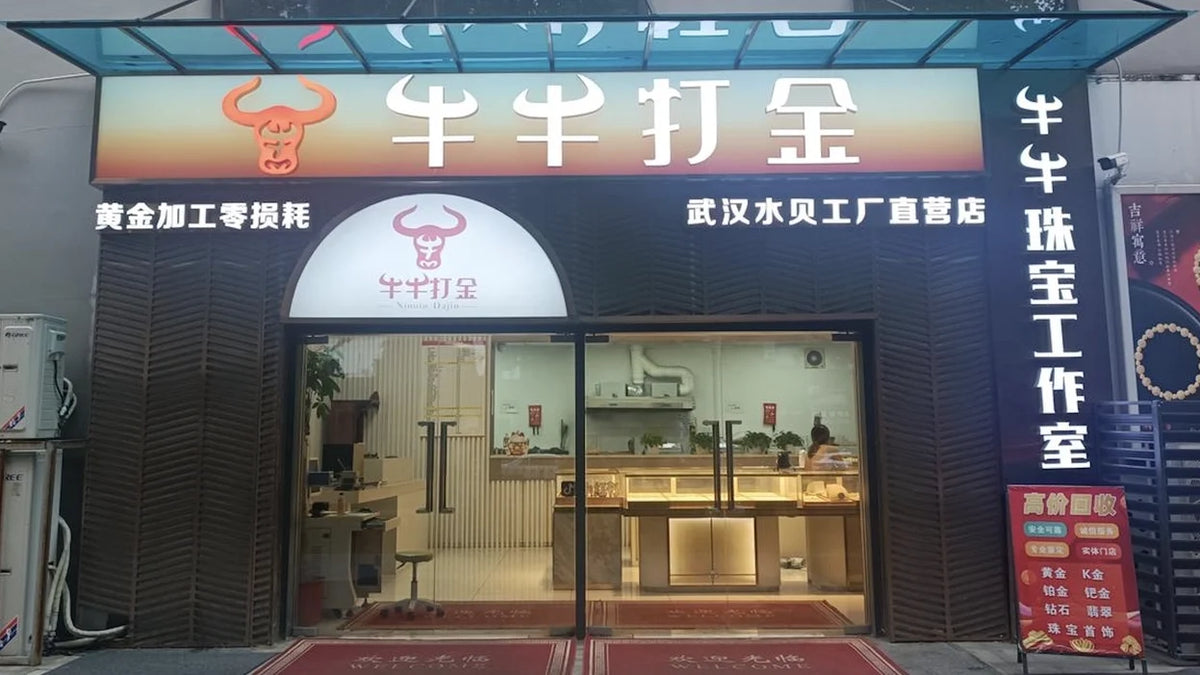
- Custom jewelry stores and boutiques. A family gold shop in Wuhan uses its WJ51C to print a dozen custom pieces a day, promising next-day delivery it could never promise while outsourcing. Read the Wuhan story here.
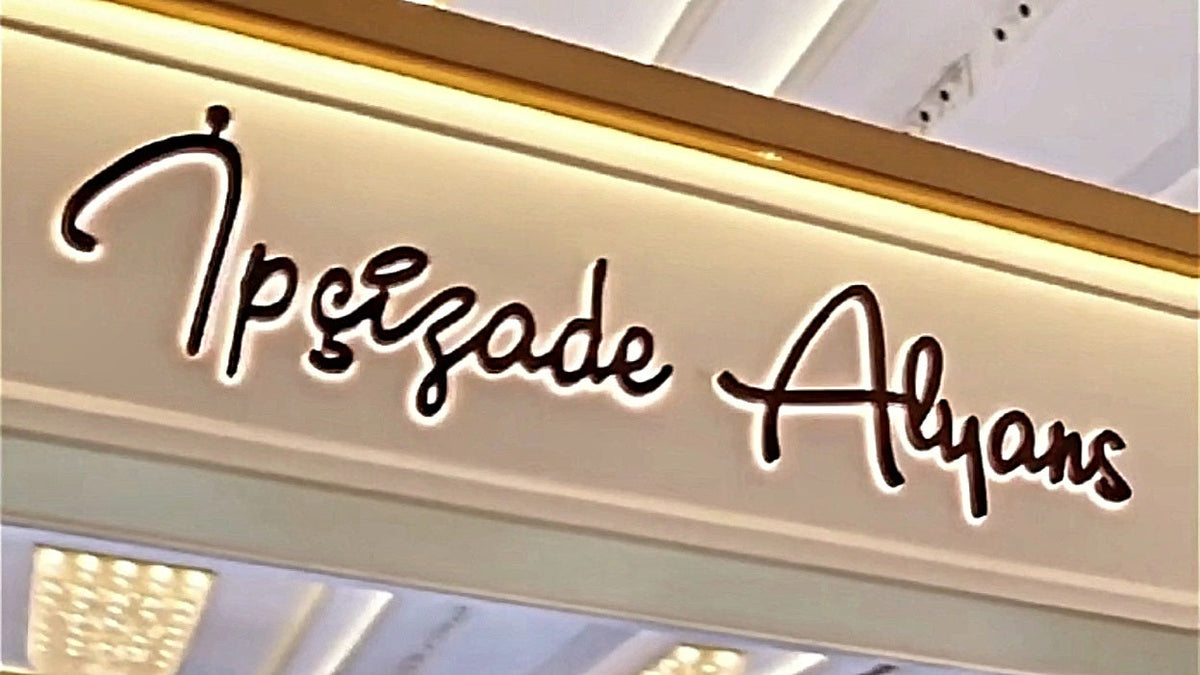
- Heritage workshops modernizing one step at a time. A 60-year-old Istanbul jewelry house added the WJ51C alongside — not instead of — its hand craftsmanship. Read the Istanbul story here.
- Small casting houses taking wax back in-house. If you currently send CAD files out and wait days for wax patterns, one machine ends the queue.
- First-time buyers. At 115 kg on standard AC power, it installs where a full industrial platform cannot.
The rule of thumb for the decision: when the monthly cost of outsourcing wax patterns — fees, waiting, reprints — starts to exceed what it costs to own and run the machine, printing in-house wins. The WJ51C is where that crossover usually happens first, and the material itself tilts the math further: the red casting wax delivers roughly 60% higher yield at 32% lower cost than conventional pattern wax. If you print well under 1 kg of wax a month, an outside service is still the more economical choice.
Which Businesses Should Choose the WJ530?
Flashforge built the WJ530 as a batch-production wax 3D printer for manufacturing plants and print service providers. It answers a different question: not "can we print our own wax?" but "how do we print all of it, every day, without adding people?"
- Jewelry manufacturers and export producers whose wax demand has outgrown single-machine output — up to 12 kg a month is the work of several desktop machines, done by one.
- Casting plants and wax print service providers running orders for other jewelers, where throughput and a 58%–60% wax utilization rate translate directly into margin.
- Workshops scaling from a WJ51C. Same WaxJetPrint software, the same red-wax-and-white-support workflow, and the same support-dissolving routine — production grows without anyone relearning the process.
- Multi-machine operations. With Wi-Fi and a 2K HD camera, one supervisor can monitor several WJ530 units remotely.
The red wax patterns also take an electroplated silver coating exceptionally well — a detail that matters for hard gold plating and enameling work. The trade-off is honest: it needs a proper installation space, which is exactly why it is not the right answer for a street-front studio.
One line to decide by: if you are tired of waiting on someone else's wax queue, the WJ51C ends it. If you have already ended it and the queue is now your own, the WJ530 clears it. Explore the WJ51C → | Explore the WJ530 → | See the full WaxJet series →
FAQ
Q1: Is the WJ530 more accurate than the WJ51C?
A1: No. Both use the same 2900 × 2900 × 1700 DPI engine at 15 μm layers and hold ±0.04 mm accuracy per 20 mm. The difference between them is production capacity, not precision.
Q2: How much wax can each printer produce per month?
A2: The WJ51C produces up to 3 kg of wax patterns a month, with 24/7 continuous production. The WJ530, with three synchronized printheads and a larger build plate, averages up to 12 kg a month — roughly four times the desktop machine's output.
Q3: Do the WJ51C and WJ530 use the same wax?
A3: Both pair a red castable wax for the pattern with a white support wax that dissolves in solution. Only the packaging differs: the WJ51C uses solid wax blocks (72 g castable / 180 g support), while the WJ530 uses bottles (1.5 or 3.0 kg castable / 1.6 or 3.6 kg support).
Q4: What is the build volume of each printer?
A4: The WJ51C offers 235 × 138 × 100 mm (about 3.2 liters). The WJ530 offers 289 × 207 × 150 mm (about 9.0 liters) — 2.8 times larger, which is what allows dense plates of patterns in a single batch.
Q5: Do both printers use the same slicing software?
A5: Yes. Both slice with WaxJetPrint, which accepts STL and SLC files and runs on Windows 10/11 64-bit. Support removal works the same way on both machines too: the white support wax dissolves in solution after printing — no scraping or hand removal.
Q6: Is the WJ530 faster than the WJ51C?
A6: Per pass, no: in single-channel mode the WJ51C prints at 7 mm/hour, above the WJ530's top speed of 6.35 mm/h. The WJ530 delivers higher total output because its three printheads work simultaneously across a much larger build plate — up to 12 kg of wax a month versus 3 kg.
Q7: Which printer is better for a small jewelry studio?
A7: The WJ51C, in almost every case. It fits an ordinary room, runs on standard AC power, and its up-to-3 kg monthly output comfortably covers a custom studio's demand. A studio printing well under 1 kg a month should still outsource; a workshop already consuming more than 3 kg a month should look at the WJ530.
Related Reading
- WJ51C Desktop Wax 3D Printer — Specifications
- WJ530 Industrial Wax 3D Printer — Specifications
- WaxJet 3D Printer Series Overview
- Customer Story: 60 Years of Craftsmanship Meets the WJ51C in Istanbul
- Customer Story: Next-Day Delivery at a Wuhan Gold Shop
- Everything You Need to Know About the Flashforge WJ530
- What Is MultiJet Printing (MJP)? MJP vs MJF Explained
- Lost-Wax Casting: From Ancient Craft to Modern Jewelry Art