Wax 3D Printer for Jewelry: How a 60-Year-Old Istanbul Workshop Prints Castable Patterns in 6–10 m²
In Istanbul's jewelry district, some workshops still measure experience not in years, but in generations. İpsizade Alyans is one of them — a family jewelry house whose craft began in the 1960s, and which today has quietly added a new tool to its bench: the WJ51C wax 3D printer.
This is the story of how six decades of hand craftsmanship and modern wax 3D printing now work side by side, in a workshop where every square meter has to earn its place.

İpsizade Alyans, a family jewelry house in Istanbul, Turkey.
From Apprentice to Master: A Craft Passed Down Since the 1960s
The story started back in the 1960s, when the family's patriarch began working as a young jewelry apprentice. Over the next forty years, he mastered the craft entirely by hand — shaping, setting and finishing piece after piece, in an era when every single pattern was carved manually out of wax.
That same discipline still defines the workshop today. İpsizade Alyans has carried its hand skills into modern production, keeping the finishing work — filing, setting, polishing — firmly in the hands of experienced goldsmiths, exactly as it was done two generations ago. What changed is only the way the pattern is born: instead of carving it, the workshop now grows it from a digital file.

A craft that started with one apprentice in the 1960s.

The bench where decades of experience were built — file, saw and hand tools.

Hand craftsmanship is still at the center of production.
The wax pattern itself, though, has always been the bottleneck of this trade — which is why the shift from hand-carved wax to printed wax is such a natural next step in the long story of lost-wax casting.
The Challenge: Limited Space, Unpredictable Orders
As production grew, so did the demands on the workshop — inside a space that could not grow with it. Like most jewelry businesses in Istanbul's Grand Bazaar area, İpsizade Alyans works in a compact unit and has had to make every square meter count.
Orders, meanwhile, rarely arrive in tidy large batches. Sometimes it is a last-minute request before a wedding. Sometimes a customer simply comes back for a few more pieces of the same design. For a workshop built on hand craftsmanship, scaling wax pattern output up and down — without losing precision — was the daily reality.
What a Small Jewelry Workshop Actually Needs
- A minimal footprint — a machine that lives on a bench or in a corner, not a production hall.
- Fast startup — power on, print, and respond to an urgent order the same day.
- Casting-grade precision — surface quality good enough for a house that has spent 60 years perfecting its finish.
That combination is exactly the gap that desktop wax 3D printers were created to fill: industrial wax-jetting output, in a format a boutique workshop can actually accommodate.
The Solution: Printing, Dissolving and Washing in 6–10 m²
That is where the FlashForge WJ51C wax 3D printer came in.

Printing, pattern removal and washing all happen inside 6–10 m².
With its compact design, the entire wax workflow — printing, pattern removal (dissolving) and washing — now takes place within just six to ten square meters, keeping the whole process close at hand. There is no separate finishing room and no sprawling production line: one corner of the workshop handles everything from digital model to castable wax pattern.
Inside the 6 m² Workflow
- Print — the CAD model is printed in castable red wax on the WJ51C build platform.
- Dissolve — support wax is removed in the integrated dissolving station.
- Wash — patterns are cleaned and dried, ready to be sprued onto the casting tree.
- Cast — the trees go into the flask and through the standard lost-wax casting cycle.
Because the WJ51C features quick warm-up and startup, the team can power it on and start printing the moment an urgent order arrives — producing small batches on demand instead of waiting for an outsourced supplier or committing to a full production run. For a workshop that has to say yes to a customer standing at the counter, that responsiveness matters as much as the resolution.
The Results: 15-Micron Precision, Consistently
Since adopting the WJ51C, İpsizade Alyans has been impressed above all by its reliable, repeatable performance — the same quality on the first model of the morning and the last one at night.
- 15-micron layer height — fine detail that holds sharp edges, filigree and stone seats true to the digital design.
- High resolution (2900 × 2900 × 1700 DPI) — crisp, accurate wax patterns print after print, thanks to MultiJet Printing (MJP) technology.
- Smooth surface finish — patterns come out ready for casting, cutting the hand rework needed before the flask goes into the burnout oven.
- On-demand small batches — a handful of rings for one client can be printed alongside a larger run without extra setup cost.

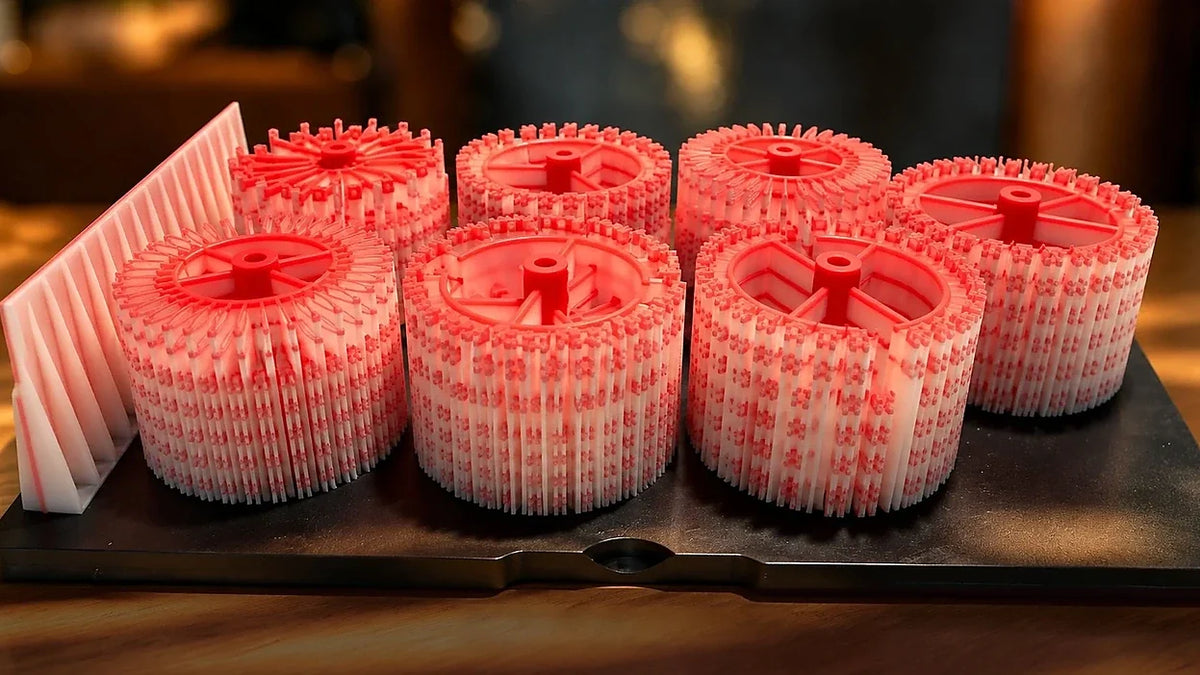
Castable wax patterns fresh off the build platform, ready for the casting tree.

Small batches on demand: dozens of wax masters produced in a single build.
From Wax Pattern to Cast Gold
These high-precision, smooth-surfaced patterns then become the foundation of the workshop's finished jewelry. The downstream steps are unchanged — spruing, investing, burnout, casting, then polishing and finishing — but they now start from a cleaner, more accurate master, which is where most downstream rework is saved.
The full production path, from a CAD file to a finished ring, is broken down step by step in our guide to how rings are made from 3D models.

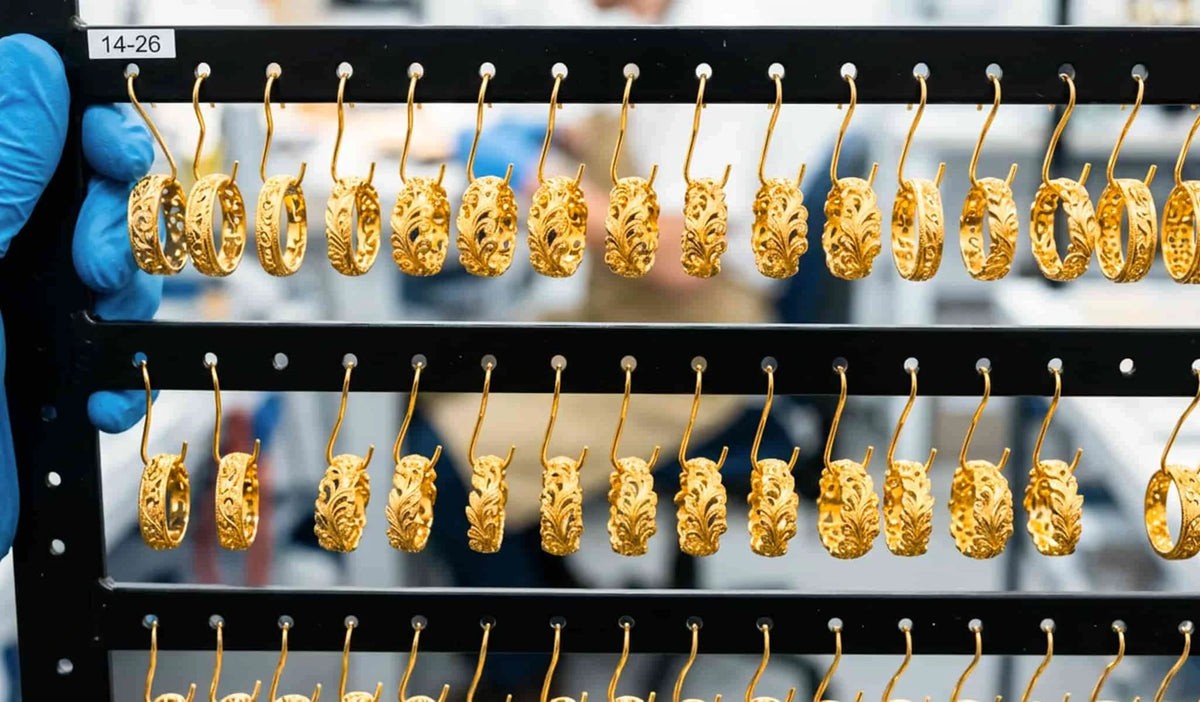
From digital wax pattern to cast gold: the finished casting trees.

Wax pattern trees handled straight out of the WJ51C.
Craftsmanship Meets Digital Wax Printing
İpsizade Alyans's story is not about replacing a master's hands with a machine. It is about giving those hands better tools: a wax 3D printer small enough to live inside the workshop, fast enough to keep up with last-minute orders, and precise enough to carry a 60-year jewelry standard into every new casting.
For a studio that outgrows the WJ51C's 3 kg monthly output, the same workflow scales up to the WJ530, which shares the 2900 × 2900 × 1700 DPI print engine with a larger build volume and higher throughput — so the process does not have to be relearned when production grows.

The WJ51C: a compact wax 3D printer built for jewelry casting workflows.
If your jewelry workshop is short on space and long on deadlines, the WJ51C was built for exactly that.
Explore the WJ51C → | Request a quote →
Frequently Asked Questions
Q1: Can a wax 3D printer fit in a small jewelry workshop?
A1: Yes. The WJ51C has a footprint of 865 × 510 × 650 mm, and the complete workflow — printing, support removal and washing — can be arranged within 6–10 m², which is why workshops in dense city centers use it as a bench-side production unit rather than a separate department.
Q2: Is a printed wax pattern good enough for lost-wax casting?
A2: Castable wax printed at 15-micron layers with 2900 × 2900 × 1700 DPI resolution produces smooth surfaces and clean burnout, which is what casting reliability depends on. It is the same material class used by industrial wax-jet systems, just in a desktop format.
Q3: Wax printing or casting resin — which should a jeweler choose?
A3: Resin printers are affordable and useful for prototypes, but wax-jet printing generally wins on surface smoothness, burnout cleanliness and casting reliability — the three factors that decide how much finishing work comes after casting.