What Is Multi Jet Printing (MJP)? MJP vs MJF Explained
Quick answer. Multi Jet Printing (MJP) builds a part one layer at a time by jetting microscopic droplets of wax or photopolymer resin through piezo printheads. Each layer hardens the instant it lands — wax cools, resin cures under UV light. Overhangs are held up by a separate support material that washes away afterwards. MJP is best known for one thing: high-precision wax patterns for investment casting. And one thing worth clearing up right away — it is not Multi Jet Fusion (MJF). Same word "jet," completely different machine.
What Is MJP?
Ask what MJP is and you'll get different answers depending on who you ask — because MJP is a brand name, not a process name. The process is material jetting. Solidscape built the first commercial machine around this idea back in 1994, under the name Sanders Prototype. 3D Systems came along later and gave its own line the MJP name. Along the way the same technology has also been sold as Multi-Jet Modeling (MJM) and Drop-on-Demand wax printing. Different labels, same machine.
Two materials travel through these machines, and they lead to very different places:
- Photopolymer. The head jets liquid resin and a lamp travelling with it cures each pass instantly. The finished part is a solid piece of cured resin — rigid or elastomeric depending on the grade — accurate enough for appearance models, fit checks and shop-floor jigs.
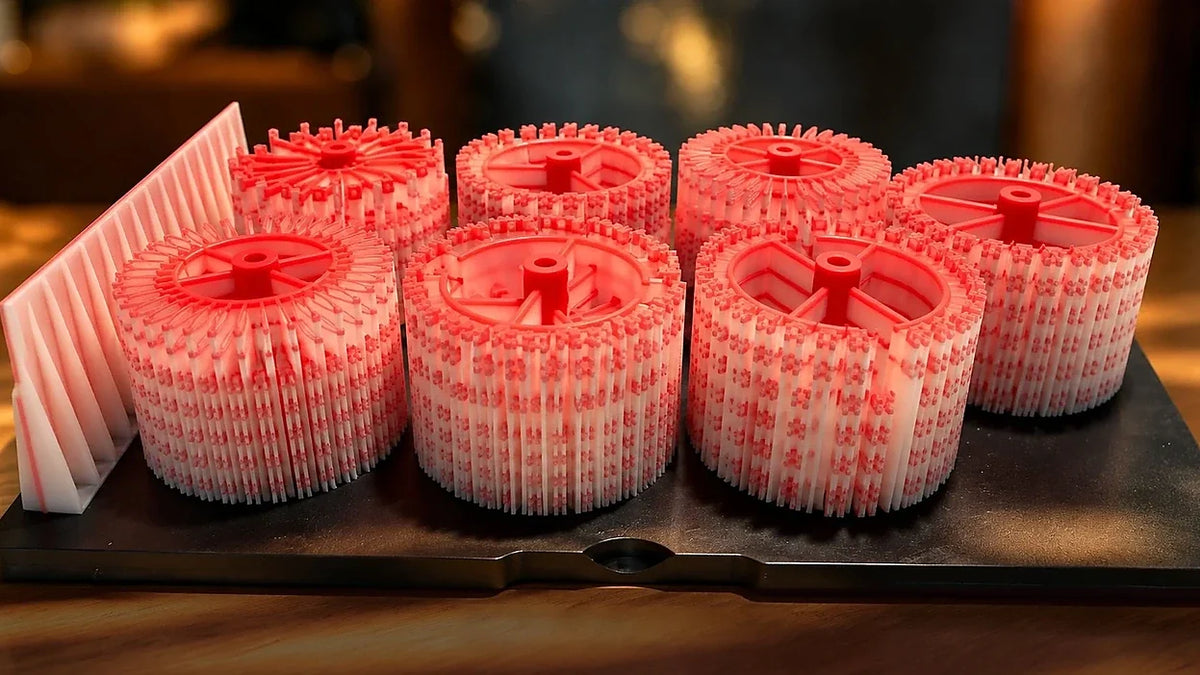
- Wax. The head jets molten casting wax, which freezes as soon as it touches the layer below. After printing, the support — a separate, alcohol-soluble wax — dissolves away, and what's left is a smooth, low-ash wax pattern made to be burned out of a ceramic shell so molten metal can take its place.

How MJP Printing Works
The machine works layer by layer, and each pass is over in seconds:
- Slicing. Software cuts the model into layers and decides where overhangs, internal cavities and floating sections need support.
- Jetting. The printhead sweeps across the build area, firing droplets out through piezo pulses — each one lands on the layer before it.
- Support. A second set of heads works the same pass, laying down support wherever the geometry needs it. This material is chemically different from the build material and is designed to dissolve completely.
- Solidification. There's no waiting between layers. Wax hardens as it cools; resin cures under UV as it's deposited. No post-cure oven either.
- Indexing. The platform drops by a single layer thickness — 8 to 32 microns on commercial machines — and the next pass begins.
- Support removal. The finished build goes into a solvent bath. The support dissolves, the pattern comes out whole.
Step 3 is what sets MJP apart. The support is not a breakaway extension of the part, so there's nothing to snap off and no scars to polish out. Internal channels, deep undercuts, delicate filigree — it all comes out of the bath clean, because no tool ever touched it.
Telling the Names Apart: MJP / MJM / PolyJet / MJF
Four names get thrown around in this space. Three of them describe genuinely related processes. The fourth doesn't belong.
| Name | Owner | Process family | What the printhead ejects | Typical material |
|---|---|---|---|---|
| Multi Jet Printing (MJP) |
3D Systems / Flashforge |
Material jetting | Resin or wax droplets | Photopolymer, 100% wax |
| Multi-Jet Modeling (MJM) | Solidscape (Prodways) | Material jetting | Wax droplets | 100% wax |
| PolyJet | Stratasys | Material jetting | Photopolymer droplets | Multi-material, full colour |
| Multi Jet Fusion (MJF) | HP | Powder bed fusion | Nothing — a fusing agent is jetted onto powder | Nylon (PA12, PA11) |
The rule of thumb: if liquid build material comes out of a printhead, it's jetting. If the machine spreads powder or cures resin from a vat, it isn't — whatever it's called.
MJF is the one that causes arguments, because it has "jet" in the name and works nothing like a jetting machine. HP's process spreads a thin bed of nylon powder, prints a fusing agent onto just the cross-section, and heat fuses the marked areas. Nothing solid ever passes through the printhead. You get tough nylon parts without supports — and no wax, which means nothing to cast with. MJP and MJF aren't really competing for the same jobs; there's no overlap in material, geometry or application.
Four names. Two actual processes.
What the Specifications Actually Mean
Spec sheets lead with two numbers — layer thickness in microns, resolution in DPI — and it's tempting to treat smaller-and-higher as automatically better. But each number describes something different:
- Layer thickness (Z) controls how much stair-stepping you'll see on curves and slopes.
- XY resolution (DPI) describes how fine the printhead's grid is in the horizontal plane. (We unpack what a 2900 × 2900 × 1700 DPI rating actually measures in this guide to DPI in wax 3D printing.)
- Droplet placement accuracy — whether each droplet lands exactly where it was aimed — is usually the real ceiling on fine detail.
- Dimensional accuracy (±x mm over y mm) is what actually reaches your finished pattern, and on intricate geometry it's the number that decides pass or fail.
- Raster texture — the faint directional grain left along the scan path — doesn't show up in any of the numbers above.
No single number sums up a machine, which is why it pays to judge patterns by what you can hold and measure, not what the datasheet says. We covered that ground in detail in why resolution isn't everything in wax 3D printing.
Where MJP Fits in Investment Casting
Put MJP next to injection wax moulding and the real difference is this: you get injection-moulded refinement without an injection mould. A mould produces exactly the geometry it was cut for. A jetted pattern can be filigree, hollow, lattice or a one-time design — printed the day the CAD file is finished. Our Cuban link chain case study shows what that flexibility looks like in real small-batch production. Layer thickness measured in microns keeps fine geometry dimensionally honest. There's no mould to design, cut, maintain or store — a serious chunk of cost and lead time gone from the front of the job — and support removal is a soak in a bath, not an afternoon at the bench. The price you pay is that everything now rides on the material, which is why the rest of this section is about wax.
The wax decides the burnout
A casting pattern has exactly one job: vanish. It has to leave the shell without cracking it and burn out without leaving anything behind — because whatever it leaves behind shows up in the metal as porosity or a rough finish.
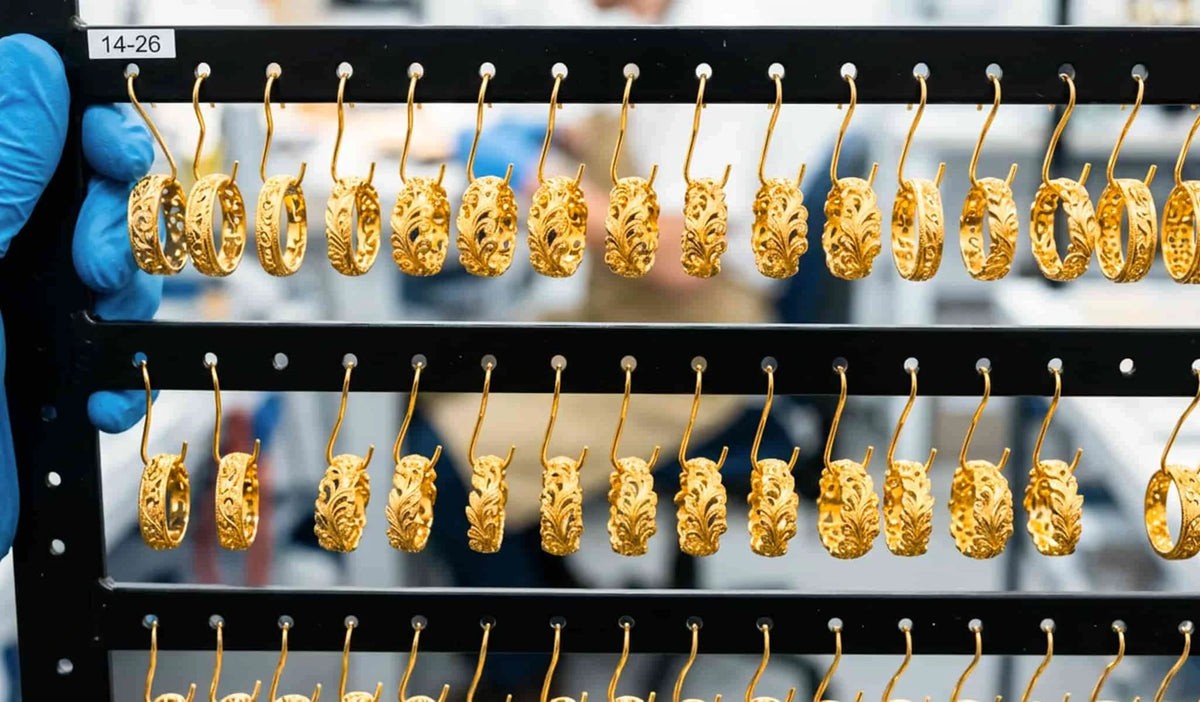
100% wax burns out inside a narrow temperature window that foundries have understood for more than a century — the same window that carried hand-carved and injected wax all along. That's the whole appeal of a jetted wax pattern: it goes into your existing burnout schedule and the furnace program doesn't change.
Castable resins are a different story. They're engineered to burn out clean, and many manage it — but the window is tighter, and it's sensitive to how fully the resin cured, how much oxygen is in the kiln, how the airflow runs and how fast you ramp. The honest framing isn't "resin is dirty." It's that the schedule has less slack. In a shop running mixed work through one kiln program, slack is what separates steady output from the occasional mystery scrap batch.
And the comparison that matters most: after burnout, 100% wax leaves essentially nothing, while castable resins leave a measurable residue — enough to read as roughness on the finished casting. Nobody in this industry publishes ash numbers, and at these concentrations independent lab testing is genuinely hard. But the gap is real, and it ends up on the surface of your castings.

Support removal is a materials problem
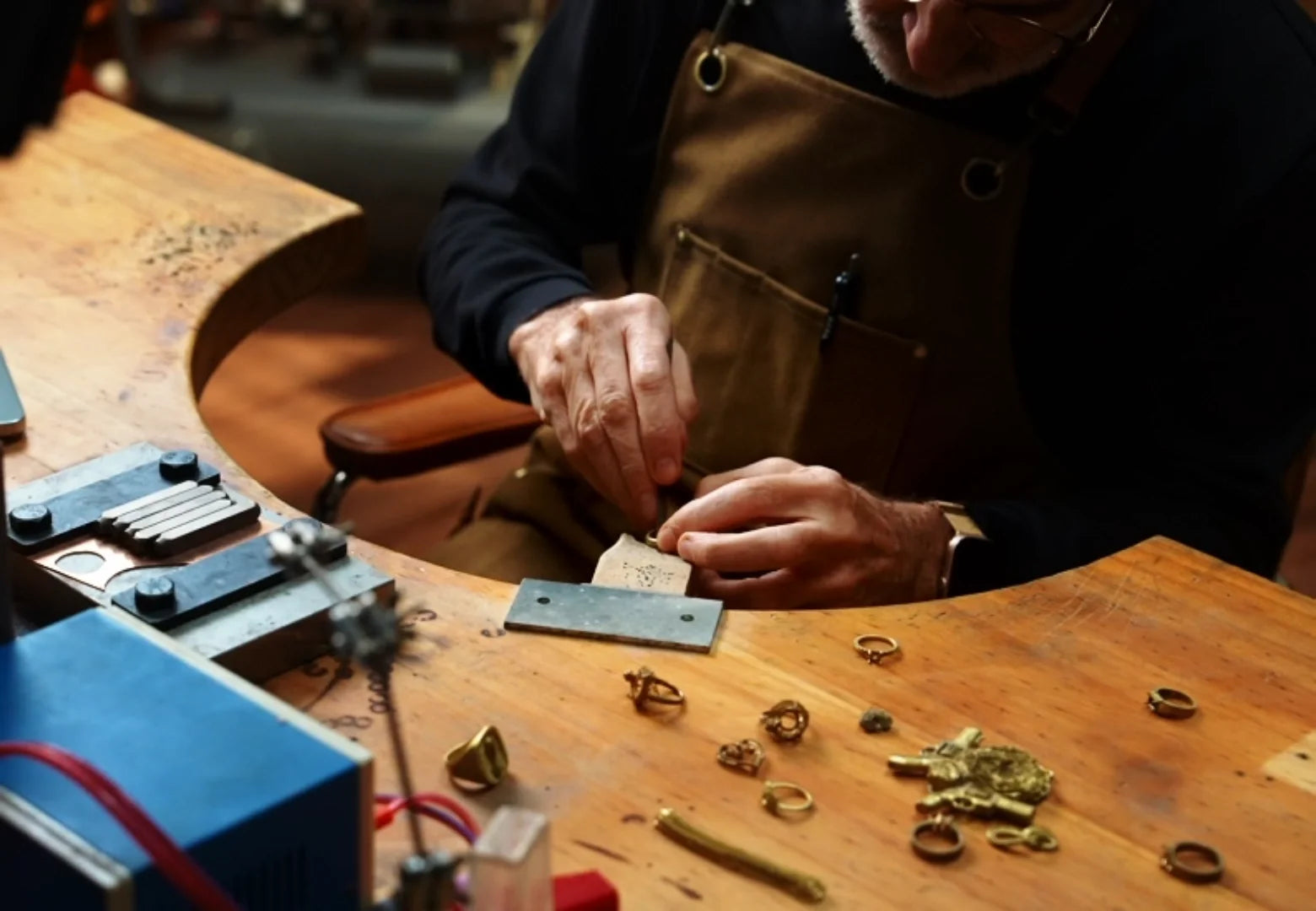
Hand-finishing supports is skilled, slow work with a scrap rate attached. Nobody enjoys clipping supports off a 0.3 mm prong and polishing out the marks it leaves.
Soluble support replaces that craft with a step. The build goes into a temperature-controlled bath — low 40s °C for alcohol-soluble wax systems — and the support lets go by itself. Nothing ever touches the pattern. The point isn't speed; it's that your output stops depending on how steady one particular pair of hands is on a given day.
Before committing to any wax system, it's worth running a simple dissolution test: how the support behaves across solution concentrations and temperatures, and what the bath does to the surface and accuracy of the pattern itself.

How the material decides the finished pattern
Wax for jetting isn't an off-the-shelf consumable. High-strength, high-melt formulations hold their shape in heavy sections and long builds — that's what you want for solid bangles and heavy rings. Low-shrinkage, fine-grain formulations protect thin walls and openwork — micro-pavé and hollow pieces. And storage matters more than most people expect: a wax that starts creeping at 30 °C is a wax that prints badly. That material-first logic is the same one behind our guide to choosing a desktop wax 3D printer for jewelry designers.
Three properties determine whether a pattern actually survives to the pour, and they change from one formulation to the next:
- Interlayer bond strength. How well layers fuse varies by formulation. Weak bonding is where cracks start — during handling, treeing or casting itself.
- Elastic recovery. Setting stones deforms the pattern. What matters is how completely it springs back — that's what decides whether the seat still grips the stone.
- Low-temperature toughness. Wax setting is done cold, and formulations differ sharply in how tough they stay when cold. That difference lands straight in your setting results.

Where MJP Wins — and Where It Doesn't
| MJP (wax) | DLP / LCD castable resin | SLA | SLS / MJF | |
|---|---|---|---|---|
| Build principle | Jetted wax droplets | Projected light, vat | Laser, vat | Powder bed |
| Typical layer | 8–32 µm | 25–50 µm | 25–100 µm | 80–120 µm |
| Support | Separate soluble wax | Manual, same material | Manual, same material | None — powder |
| Burnout | Standard wax schedule | Narrower, schedule-sensitive | Castable via hollow build (QuickCast) | Not applicable |
| Best fit | Fine-detail casting patterns, batch work | Low entry cost, fast iteration | Large smooth masters | Tough functional parts |
| Main failure mode | Pattern brittleness, limited toughness | Post-process variables | Support scars | Surface granularity |
Some limits deserve saying out loud, because they're exactly where MJP gets oversold:
- Jetted wax is brittle. Thin, tall, unsupported geometry can crack during handling and treeing. That's the nature of the material, not a defect in the machine — plan the workflow around it.
- Output is limited by scanning. The head must visit every point of every layer, so a jetting machine doesn't get faster the way a projector or a powder bed does. MJP wins on parts per batch and on detail — not on raw volume per hour. (The trade-off between speed and output is exactly what single- versus dual-channel printing is about.)
- Photopolymer MJP parts aren't engineering plastics. Under sustained load they creep; under UV and heat they yellow. If a part needs to carry load outdoors for a year, look somewhere else.
Frequently Asked Questions
Q1: What does MJP stand for?
A1: Multi Jet Printing. It's 3D Systems' brand name for the material jetting process: wax or photopolymer droplets deposited layer by layer, each one solidified as soon as it lands.
Q2: Is multi jet printing the same as multi jet fusion?
A2: No. MJP jets liquid build material from a printhead. MJF spreads nylon powder and jets a fusing agent into it, then fuses it with heat. Different physics, different materials, different jobs.
Q3: Is MJP the same as PolyJet?
A3: They're cousins. Both are material jetting and both use piezo printheads. PolyJet (Stratasys) is built around multi-material, full-colour photopolymer parts; MJP (3D Systems) has the stronger casting-wax line. Same family, different specialties.
Q4: What materials can MJP print?
A4: Two families: UV-curable photopolymers (rigid, elastomeric, high-temperature, biocompatible, composite) and 100% wax. Wax systems use a separate alcohol-soluble support wax — the build wax and the support wax are never the same material.
Q5: Can MJP wax patterns be cast directly?
A5: Yes. Tree it, invest it in ceramic shell, burn it out on a standard lost-wax schedule and pour. No intermediate mould, no conversion step.
Q6: Do MJP prints need support removal?
A6: They do, but not by hand. The support dissolves completely in a solvent bath — which is exactly why internal channels and fine openwork come out intact.
Q7: Is MJP worth it compared with castable resin?
A7: Depends on your volumes and how much process variability you can live with. Resin is far cheaper to start with and fine for one-offs. Jetted wax earns its keep on steady batch work, where a predictable burnout and hands-off support removal mean less rework.
Want to see the process running in a real workflow? The WJ51C desktop wax 3D printer brings jetted wax patterns to studios and small workshops, and our jewelry industry overview shows how the pieces fit together, from CAD file to cast part.