Filigree Jewelry Wax Printing Test Results with the WJ51C
Filigree jewelry is widely recognized as one of the most precision-demanding categories in jewelry manufacturing. With ultra-fine wire structures, intricate layered details, and complex openwork surfaces, filigree designs place extremely high demands on wax pattern precision and surface quality.
Whether produced through traditional wax carving or standard 3D printing technologies, maintaining clean details and smooth surfaces at such a small scale remains a major challenge.
To evaluate real performance in high-detail jewelry production, our team recently conducted a series of filigree wax printing tests using the WJ51C. The test models included filigree rings, pendants, and earrings with highly complex structures. In this article, we will take a closer look at the printing results and overall surface quality performance.

1. Characteristics and Printing Challenges of Filigree Jewelry
The defining feature of filigree jewelry lies in its intricate decorative structures formed by extremely fine metal wires. These designs typically include:
- Ultra-fine linear structures
- Large openwork areas
- Multi-layer interwoven textures
- High-density decorative details
- Complex curved surface transitions
Compared with conventional jewelry styles, filigree jewelry places far higher demands on wax pattern quality. As structures become smaller and more delicate, the risk of the following issues increases significantly:
- Structural breakage
- Detail loss
- Rough edges
- Visible layer lines or surface waviness
- Casting defects or failures
In jewelry wax pattern production, the real challenge is not simply whether a model can be printed, but whether extremely small structures can still maintain:
- Clean and sharp edges
- Smooth surface quality
- Stable fine-detail reproduction
- Reliable casting performance
Traditional hand-carved wax methods are difficult to use for structures of this complexity. Even when achievable, they often suffer from long production cycles and poor consistency between pieces.
Meanwhile, standard resin-based 3D printing technologies can reproduce some complex geometries, but they still struggle to meet the requirements of high-end filigree jewelry in terms of surface smoothness, fine-detail stability, and final casting performance.
For this reason, filigree jewelry has long been regarded as one of the most demanding benchmark applications for evaluating the precision and surface quality capabilities of wax 3D printers.
2. WJ51C Printing Performance on Filigree Jewelry
In this test, the WJ51C was used to print multiple highly complex filigree jewelry models, including:
- Filigree rings
- Filigree pendants
- Filigree earrings
- Multi-layer interwoven texture structures
From the final results, the WJ51C demonstrated clear advantages in both detail reproduction and surface quality.

2.1 High Precision in Fine Structure Reproduction
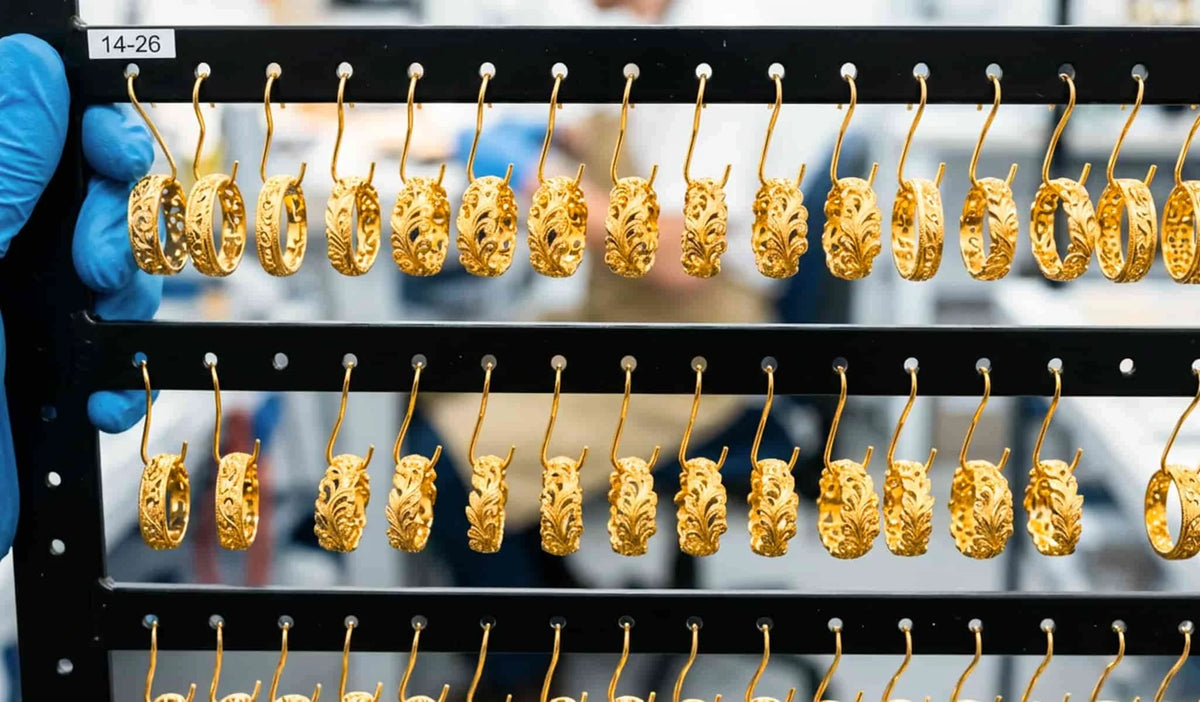
In many ultra-fine filigree areas, the thin wire structures remained clearly separated without obvious merging, deformation, or structural collapse. This is particularly important for filigree jewelry, where even minor detail loss can significantly reduce the visual depth and refinement of the final piece.
The WJ51C maintained strong detail integrity even in highly complex interwoven regions, allowing delicate filigree patterns to remain clean and well-defined throughout the entire model.
The detailed printing results can be seen in the images below.
2.2 Smooth and Refined Surface Quality
Compared with the visible layer lines or “water ripple” textures commonly found in traditional wax printing, the WJ51C produced noticeably smoother surfaces on curved filigree structures.
This improvement was especially visible in areas such as:
- Curved transition surfaces
- Arc-shaped geometries
- Filigree connection edges
- Small-radius curved details
These are typically the most difficult regions to maintain surface smoothness. However, the printed wax patterns still retained a highly refined surface finish with minimal visible texture.
Many of the test models required little to no additional post-processing before entering the casting workflow. This not only reduced manual finishing time, but also lowered the risk of damaging delicate filigree structures during surface cleanup and polishing.

3. A Desktop Wax 3D Printer Better Suited for Complex High-End Jewelry Design
For filigree jewelry, the real challenge is not simply whether a model can be printed, but whether extremely fine structures can maintain stable, high-precision detail reproduction at a very small scale. This is exactly where the WJ51C demonstrated its core advantage throughout the testing process.
The WJ51C features a printing resolution of 2900 × 2900 × 1700 DPI with a minimum layer thickness of approximately 15 μm, allowing complex microstructures to retain sharp details while maintaining smooth surface quality.
As jewelry design continues moving toward more intricate, personalized, and high-end styles, high-precision desktop wax 3D printing is becoming an increasingly important tool in modern jewelry design and production workflows.