What Causes Water Ripple Textures in Jewelry Wax 3D Printing?
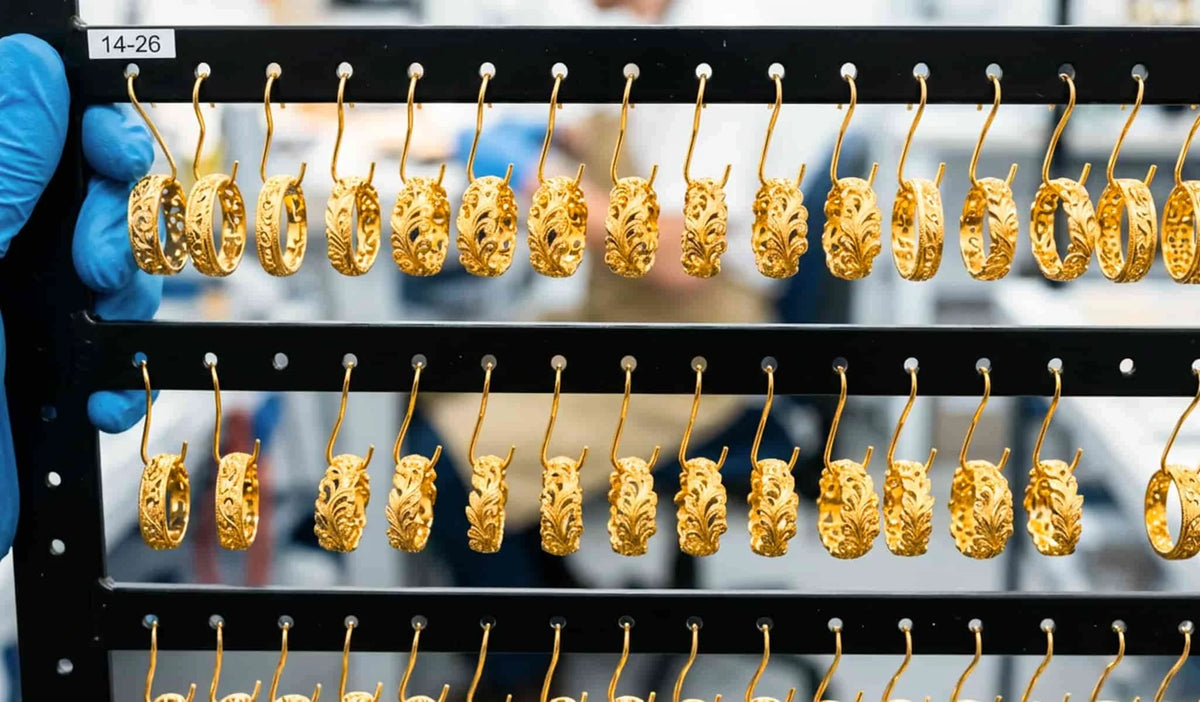
In jewelry wax 3D printing, many users notice an important difference the first time they examine a finished wax pattern under direct lighting: some models appear exceptionally smooth, while others show subtle layered textures resembling water ripples across the surface. For ordinary industrial parts, these textures may not be considered a major issue. However, in the jewelry industry, the smoothness and fineness of the wax pattern surface directly affect the quality of the final casted metal piece.
If obvious ripple textures remain on the wax model, even after polishing, they can still lead to increased manual post-processing time, loss of fine details, uneven mirror finishes, reduced premium appearance, and even higher casting failure risks. For this reason, reducing water ripple textures has long been regarded as one of the most critical technical challenges in jewelry wax 3D printing.

1. What Are “Water Ripple” Textures in Jewelry Wax Printing?
Water ripple textures are essentially periodic surface patterns formed by the continuous accumulation of microscopic printing deviations during the manufacturing process. Unlike traditional molding methods, 3D printing does not create the model in a single step. Instead, the entire wax pattern is built gradually through layer-by-layer deposition, continuous scanning paths, constant printhead movement, and repeated platform elevation. As a result, even extremely small instabilities during printing — including mechanical vibration, motion deviation, platform shaking, inconsistent material jetting, or imperfect path control — can become permanently recorded on the model surface layer after layer.
These accumulated deviations eventually appear as visible wave textures, layer lines, circular banding, ripple marks, or curved surface striping. Because jewelry wax patterns are typically very small and contain highly detailed curved surfaces, even tiny motion inconsistencies can become visually amplified. In many cases, the circular patterns visible on curved surfaces are actually the direct result of the machine’s movement trajectory and layered printing paths.
This effect becomes especially noticeable on continuous curved geometries such as ring exteriors, spherical structures, and arc-shaped surfaces. Since these geometries are constructed through stacked slices, natural boundaries form between layers. In the 3D printing industry, this phenomenon is commonly referred to as “stair-stepping.” The larger the layer thickness, the more visible the staircase effect becomes. In jewelry manufacturing, even these extremely fine surface variations can disrupt light reflection on polished metal surfaces, causing mirror finishes to appear uneven and ultimately reducing the perceived quality of the final jewelry piece.
This is precisely why jewelry wax 3D printing places strong emphasis on Z-axis resolution, minimum layer thickness, and printing path optimization algorithms. These factors directly determine the smoothness of curved surfaces and the visibility of ripple textures. For example, a 15 μm layer thickness can produce dramatically smoother surface transitions compared with conventional layer settings, particularly on high-end jewelry models where users carefully evaluate gloss consistency, curved surface continuity, and reflective smoothness.
2. Mechanical Vibration Is One of the Main Causes of Water Ripple Textures
During wax jet 3D printing, the printhead must move continuously at high speed. If the machine structure lacks sufficient rigidity or stability, high-frequency vibration, mechanical resonance, micro-shaking, and motion deviation can occur throughout the printing process. Although these movements are extremely small, they continuously accumulate during high-precision jewelry printing and eventually appear as periodic surface ripple patterns on the finished wax model.
This issue becomes even more noticeable when the machine has a larger overall structure, longer motion systems, wider guide rail spans, or operates at higher printing speeds. Any small vibration during movement can directly affect printhead positioning consistency. Since wax jet printing requires extremely accurate droplet placement, even slight positional deviation can generate visible surface texture repetition.
For this reason, many high-end wax 3D printing systems now focus heavily on improving overall structural rigidity, guide rail stability, motion architecture, dynamic balancing, and vibration control. Mechanical stability itself has become one of the most important foundations for achieving smooth jewelry wax surfaces.

3. Printhead Movement and Platform Motion Also Affect Surface Quality
Beyond mechanical vibration, the movement behavior of the printhead and build platform is another major source of water ripple formation. During printing, the printhead continuously moves while jetting wax droplets, the platform gradually rises layer by layer, and the system constantly switches between motion paths and printing trajectories.
Jewelry wax printing requires extremely precise synchronization between all movement systems. If printhead speed fluctuates, platform elevation contains small positioning errors, jetting timing becomes inconsistent, or path transitions are not smooth enough, the arrangement of wax droplets becomes uneven. These inconsistencies eventually appear on the surface as circular patterns, wave textures, striped reflections, or layered gloss variations.
Such issues become particularly visible on large curved surfaces, smooth arcs, and small-radius rounded geometries because these areas are highly sensitive to light reflection. Even extremely fine texture inconsistencies can become immediately visible to the naked eye once the surface reflects direct lighting.
4. Why Are Curved Surfaces More Likely to Show Ripple Textures?
In jewelry models, the areas most likely to display water ripple textures typically include ring exteriors, spherical structures, curved pendants, sculpted faces, embossed surfaces, and flowing curved edges. The reason is that curved geometry is naturally continuous, while 3D printing technology fundamentally relies on approximating those continuous surfaces using countless discrete layers.
In simple terms, the printer is effectively constructing a curved object by stacking extremely thin slices one layer at a time. If the layer thickness is too large, the curve changes rapidly, the printhead movement lacks stability, or the printing path transitions are not sufficiently optimized, these problems become dramatically amplified on curved surfaces.
This is why the true test of a jewelry wax 3D printer’s surface quality is often not whether it can produce complex hollow structures, but whether it can maintain smoothness across large continuous curved surfaces. Curved geometries reveal almost every underlying printing issue, including layer lines, vibration artifacts, path deviations, uneven droplet placement, and platform movement errors.
This is also why many high-end jewelry brands pay close attention to whether the outer surface of a ring appears sufficiently smooth. Ring exteriors are often the easiest area for evaluating the true surface quality performance of a wax 3D printing system.
5. Why Some Ripple Textures Cannot Be Fully Removed by Polishing
Many people assume that surface ripple textures can simply be removed through additional polishing and post-processing. However, in jewelry manufacturing, excessive polishing itself introduces significant risks. Jewelry models are often extremely small, especially in areas containing filigree structures, micro pavé settings, engraved text, and ultra-fine decorative textures. If aggressive manual finishing is required to eliminate layer marks, important details can easily become softened, rounded, or partially lost.
Excessive polishing can also affect dimensional accuracy and stone-setting precision. This is why the high-end jewelry industry increasingly emphasizes achieving smooth surfaces directly from the printing stage rather than relying on heavy post-processing correction afterward.
Truly high-quality wax printing should already deliver refined surface quality immediately after printing. Only in this way can jewelry manufacturers preserve intricate design details, reduce labor-intensive finishing work, minimize the risk of damaging delicate structures, and achieve a cleaner final casting appearance with a more premium visual finish.